Logistic Regression

Fitted and Residuals

In this lecture

  • Fitted values

  • Residuals

  • Diagnostics

Prediction in SLR

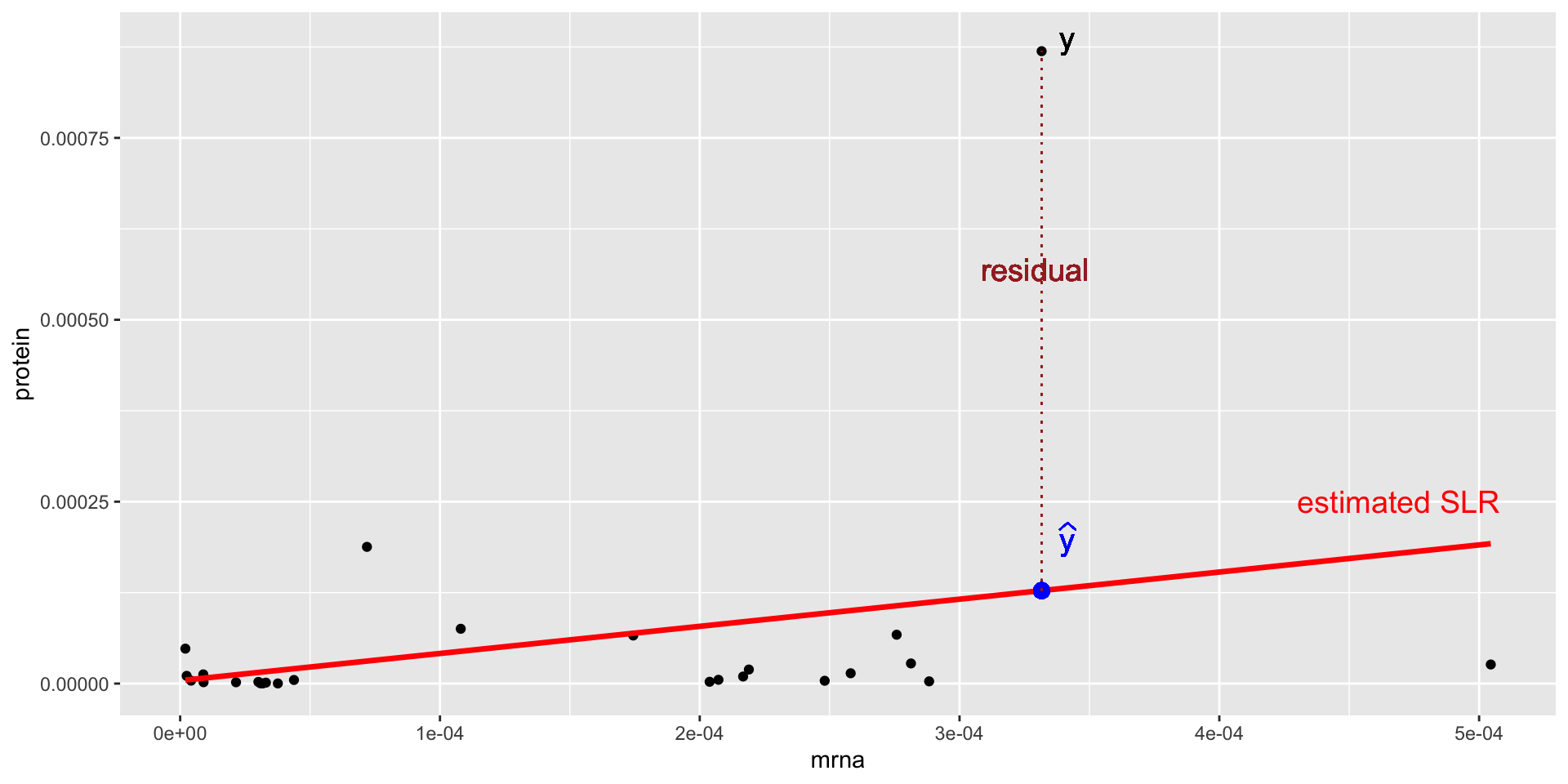
Predicted values

Scroll down to see full content

  • They are random variables since they are functions of the estimated coefficients

we can estimate their standard error and CI!! (later in the course)

  • Notation: we add a “hat” to distinguish the observed from the predicted value

\[ y \text{ vs. } \hat{y}\]

  • In R output all predicted values are stored in the column .fitted.

For the SLR case:

\[ \hat{\text{prot}}_{t} = 4.18 \times 10^{-6} + 0.37 \text{ mrna}_{t}\]

The residuals

Scroll down to see full content

The residual is the difference between the observed and the predicted value of the response

In R output all residuals are stored in the column .resid.

\[ \text{res}_i = y_{i}-\hat{y}_{i}\]

Note that:

\[\varepsilon_i \ne \text{res}_i\]

The residuals are the prediction errors.

The errors are a random variable that we do not observe. We observe the residuals instead.

In our case:

\[ \text{res}_t=\text{prot}_{t}-\hat{\text{prot}}_{t}\]

Back to Logistic Regression

To simplify the notation, let \(L_i\) be the linear component and \(p_i\) the conditional probability:


\(L_i=\beta_0 + \beta_1X_{1i} + \beta_2X_{2i} + \ldots + \beta_pX_{pi}\)

and,

\[ E\left[\ Y_i\ |\ X_{1i}, \ldots, X_{pi}\ \right] = P\left[\ Y_i = 1\ |\ X_{1i}, \ldots, X_{pi}\ \right] = p_i \]

Logistic Regression: equivalent forms

Scroll down to see full content

Recall that a logistic model can be written in different forms.


\[ p_i = \frac{e^{L_i}}{1+ e^{L_i}} \qquad [\text{probability}] \]

\[ \underbrace{\log\left(\frac{p_i}{1 - p_i}\right)}_{\textbf{the logit function}} = L_i \qquad [\text{log-odds}] \]

\[ \underbrace{\left(\frac{p_i}{1 - p_i}\right)}_{\textbf{odds}} = e^{L_i} \qquad [\text{odds}] \]

Prediction

The estimated model can be used to predict an outcome

  • the predicted outcome depends on the form of the model
    • log-odds (default, since this is a linear model)
    • probabilities
    • odds
  • we can predict the outcome of:
    • observations in the same sample used to estimate the model, called fitted values
    • new observations, usually refered as predicted values

Dataset and model

Let’s use the Titanic dataset and an additive model with sex and fare as covariates to illustrate concepts.

model_titanic_logistic_additive <- glm(survived ~ sex + fare, data = titan,
                                       family = binomial) 

tidy(model_titanic_logistic_additive) %>%
  mutate_if(is.numeric, round, 3) %>%
  knitr::kable()
term estimate std.error statistic p.value
(Intercept) 0.647 0.149 4.358 0
sexmale -2.423 0.171 -14.208 0
fare 0.011 0.002 4.886 0

Prediction

Scroll down to see full content

Suppose we want to use the predicted model to predict the odds of surviving for a male passenger who paid a fare of $7.25.

The predicted log-odds are

\[\begin{gather*} \log\left(\frac{\hat{p}_s}{1 - \hat{p}_s}\right) = \underbrace{0.647}_{\hat{\beta}_0} - \underbrace{2.423}_{\hat{\beta}_1} \times 1 + \underbrace{0.011}_{\hat{\beta}_2} \times 7.25= -1.696 \end{gather*}\]

Next, by exponentiating both sides of the equation, we obtain the predicted odds:

\[ \frac{\hat{p}_s}{1 - \hat{p}_s} = e^{-1.696} = 0.183 \]

Finally, solving the above for \(\hat{p}_s\), we obtain our predicted probability of surviving

\[ \hat{p}_s = \frac{e^{-1.696}}{1+e^{-1.696}} = \frac{0.183}{1.183}=0.155 \]
in R

predicted log-odds (default)

predict(model_titanic_logistic_additive,
            tibble(sex = "male", fare = 7.25),
            type = "link") %>% round(3)
     1 
-1.694 


predicted probabilities

predict(model_titanic_logistic_additive,
            tibble(sex = "male", fare = 7.25),
            type = "response") %>% round(3)
    1 
0.155 

Fitted values

In R there are different ways of obtaining fitted values.

It is important to know which forms are given by which function.

  • the augment() function adds .fitted to the dataset: these are predicted log-odds

  • the element $fitted or function fitted() of the estimated model object gives the predicted probabilities

  • predicted odds can be computed from these columns

model_titanic_logistic_additive %>%
              augment() %>%
              dplyr::select(survived,sex, fare,.fitted) %>%
              mutate(pred_prob1 = model_titanic_logistic_additive$fitted,
                     pred_prob2 = fitted(model_titanic_logistic_additive))  %>%
              head() %>%
              mutate_if(is.numeric, round, 3) %>%
              knitr::kable()
survived sex fare .fitted pred_prob1 pred_prob2
0 male 7.250 -1.694 0.155 0.155
1 female 71.283 1.446 0.809 0.809
1 female 7.925 0.736 0.676 0.676
1 female 53.100 1.243 0.776 0.776
0 male 8.050 -1.685 0.156 0.156
0 male 8.458 -1.681 0.157 0.157

Residuals

Scroll down to see full content

The raw residuals are, as usual, the differences between the observed and the fitted values.

\[\begin{aligned} r_i &= \text{obs}_i - \text{fit}_i \\ &= y_i - \hat{p}_i \end{aligned}\]

However, there are 2 problems with these residuals:

  • the residuals are not properly scaled since the variance of the observations is not constant! for a binary response:

\[Var(Y_i) = p_i(1-p_i)\]

technically, we should write the conditional variance and probability

Thus, residuals of different observations are not comparable and should be adjusted!!


  • the raw residuals have values \(-\hat{p}_i\) and \(1- \hat{p}_i\), respectively, since the \(y_i\) take only 2 values \(y_i = 0\) and \(y_i = 1\). This creates 2 lines in usual residual plots.

Residuals for GLMs

Scroll down to see full content

Many variations of the raw residuals have been proposed for GLMs that take the variance of the observations into account.

  • Pearson residuals: divides the raw residuals by the standard deviation of the response

\[r_i = \frac{y_i - \hat{p}_i}{\sqrt{\hat{p}_i(1-\hat{p}_i)}}\]

  • deviance residuals

  • standardized residuals: for both Pearson and deviance residual

We won’t get to the details of these but it is important to know which ones you are calculating

model_titanic_logistic_additive %>%
              augment() %>%
              dplyr::select(survived,sex, fare,.fitted, .resid,.std.resid) %>%
              mutate(pred_prob = model_titanic_logistic_additive$fitted,                  
                     resid_raw = residuals(model_titanic_logistic_additive, type = "response"),
                     raw_byhand = survived - pred_prob,
                     resid_deviance = residuals(model_titanic_logistic_additive),
                     resid_pearson =residuals(model_titanic_logistic_additive,"pearson"),
                     pearson_byhand = resid_raw/sqrt(pred_prob*(1-pred_prob)),
                     resid_standardized =rstandard(model_titanic_logistic_additive)) %>%
              head() %>%
              mutate_if(is.numeric, round, 3) %>%
              head(3) %>% 
              knitr::kable()
survived sex fare .fitted .resid .std.resid pred_prob resid_raw raw_byhand resid_deviance resid_pearson pearson_byhand resid_standardized
0 male 7.250 -1.694 -0.581 -0.581 0.155 -0.155 -0.155 -0.581 -0.429 -0.429 -0.581
1 female 71.283 1.446 0.650 0.652 0.809 0.191 0.191 0.650 0.485 0.485 0.652
1 female 7.925 0.736 0.885 0.887 0.676 0.324 0.324 0.885 0.692 0.692 0.887

Diagnostics

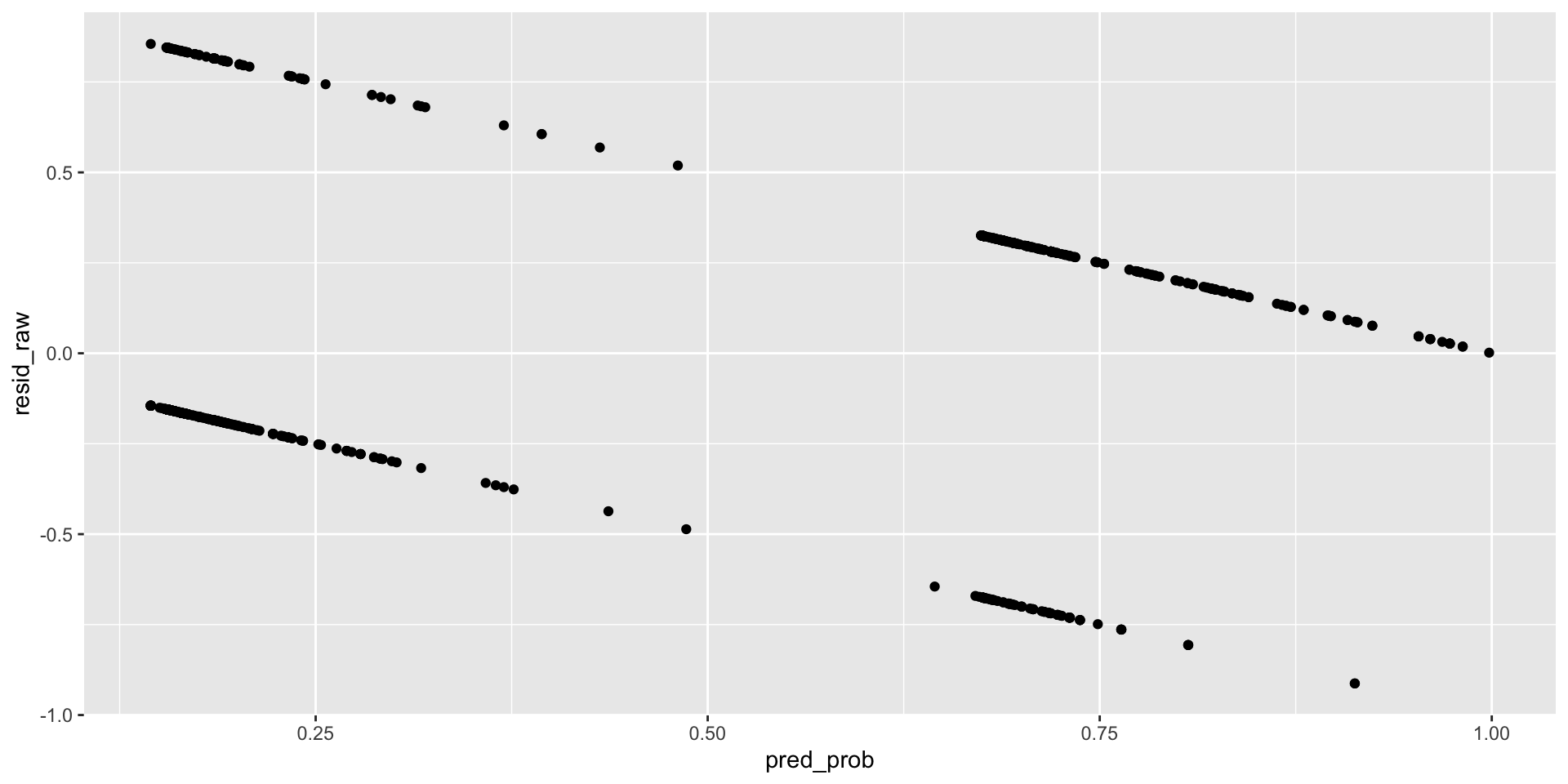
As we mentioned before, the raw residuals give only 2 values \(-\hat{p}_i\) or \(1-\hat{p}_i\), which creates 2 straight lines in the residuals plots


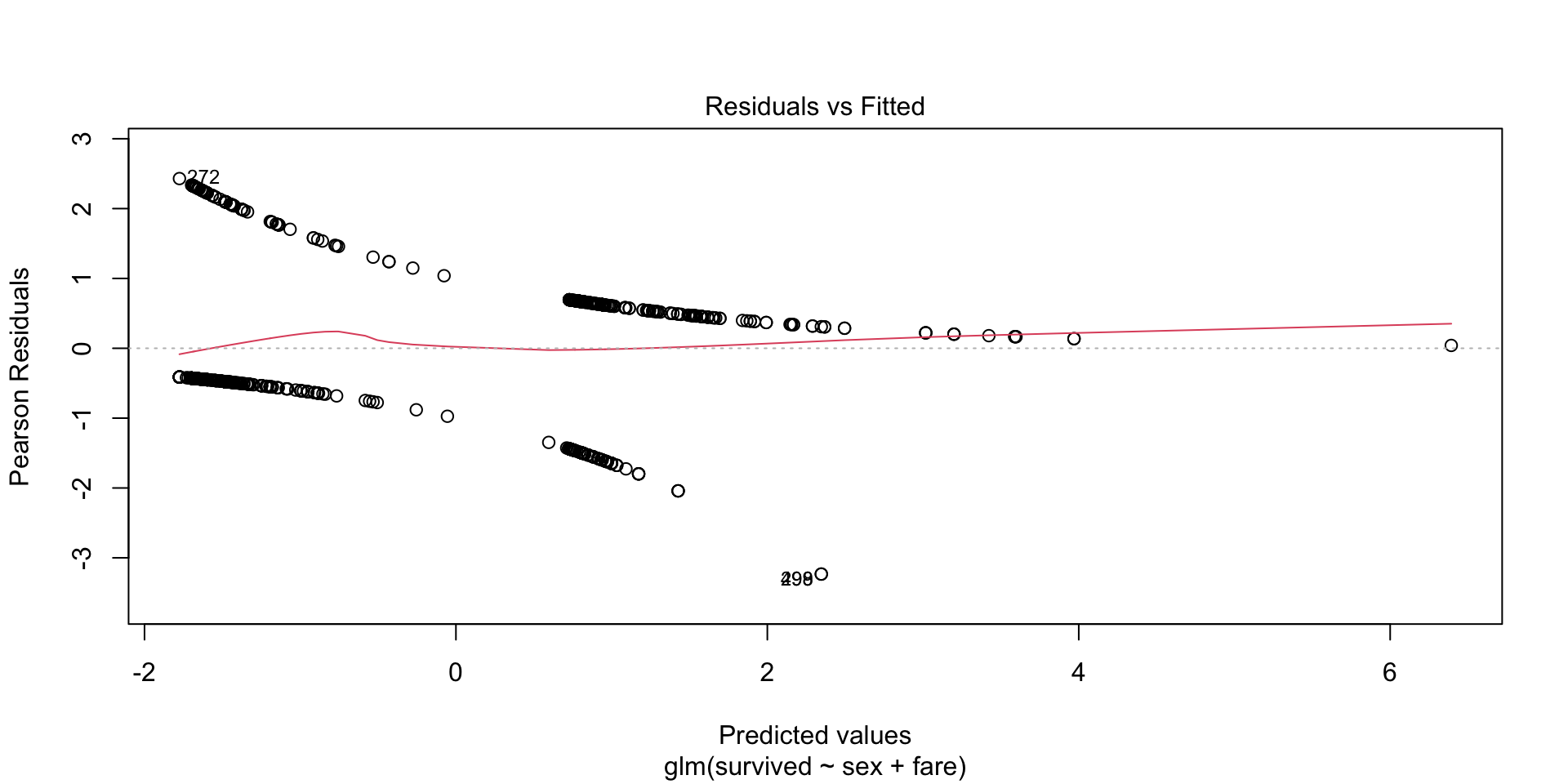
Not much is gained using the Pearsons residuals, the problem stems from having a binary response


Although these are hard to interpret, we don’t want to see clear patterns in a residuals plot.

model_titanic_logistic_additive %>%
            augment() %>%
            mutate(pred_prob = model_titanic_logistic_additive$fitted,                   resid_raw = residuals(model_titanic_logistic_additive, type = "response")) %>%
            ggplot(aes(x= pred_prob,y=resid_raw)) +
            geom_point()

plot(model_titanic_logistic_additive,1)

Binned residuals plot

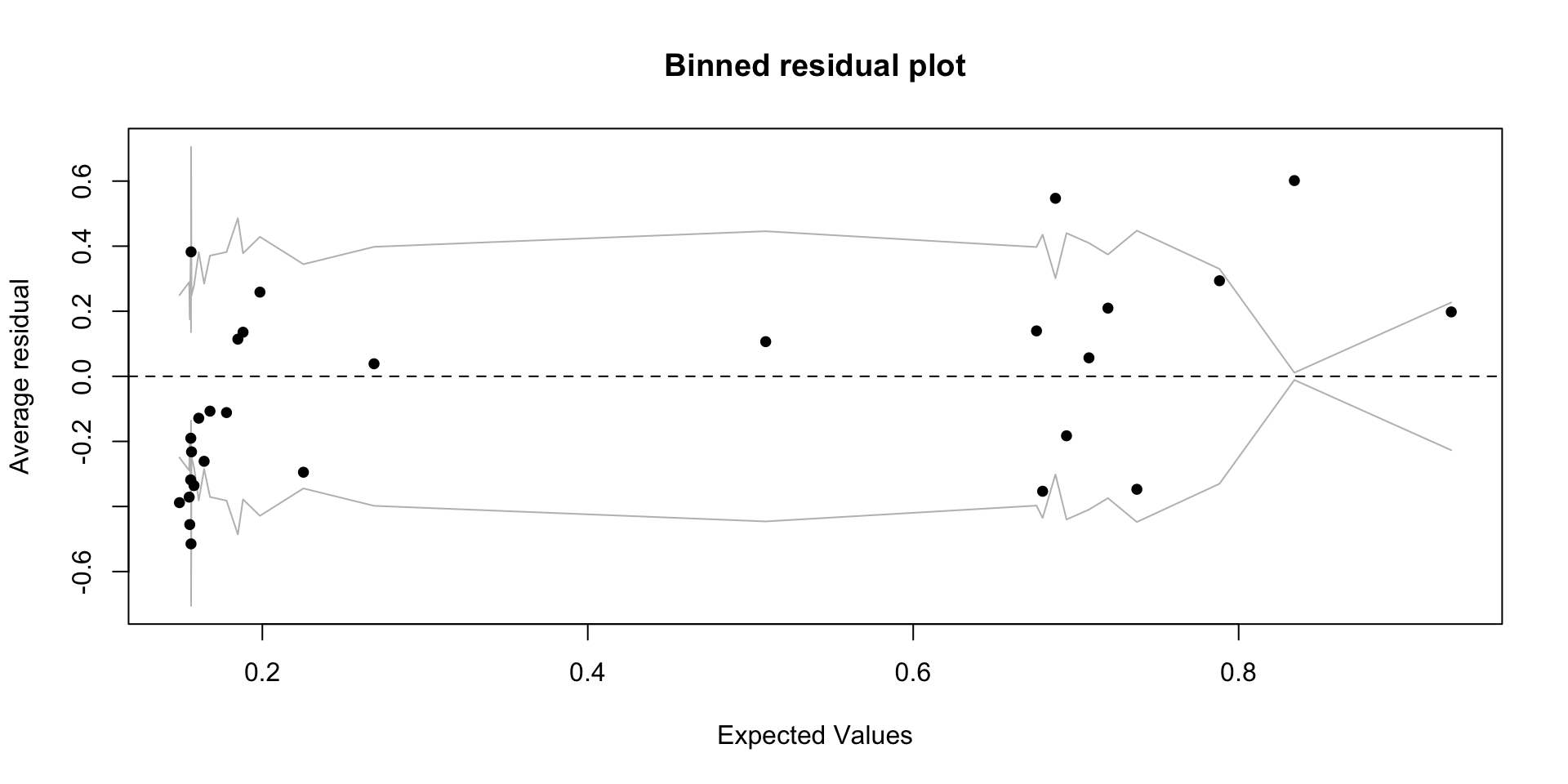
To address this problem, the binned plot has been proposed. Points are binned and the summary of each bin is plotted.

y_resid <- residuals(model_titanic_logistic_additive)
x_fit <- model_titanic_logistic_additive$fitted

residual_plot <- binnedplot(x_fit, y_resid)

Overdispersion

A more important problem to address in the case of logistic regression is the problem of overdispersion.

  • As mentioned before, the logistic regression is built assuming that the response has a Bernoulli distribution, which means that the estimated variance of the response has to be \(\hat{p}(1-\hat{p})\).

  • Unfortunately, in real applications, even in situations where the model seems to be estimating the mean well, the data’s variability is not quite compatible with the model’s assumed variance.

Fixing the overdispersion

This misspecification in the variance affects the SE of the coefficients, not their estimates.

  • A more flexible estimate of the model can be obtained using a method called quasi-maximum likelihood

  • The estimated model also gives an estimate of the overdispersion parameter, as well as correct the standard error of our estimators.

  • If the model is correctly specified, the estimated overdispersion parameter is 1. Values above or below 1 indicate over- or under- dispersion

Scroll down to see full content

An easy implementation is obtained using the family argument to a quasibinomial.

summary(glm(
    formula = survived ~ sex + fare,
    data = titan,
    family = quasibinomial))

Call:
glm(formula = survived ~ sex + fare, family = quasibinomial, 
    data = titan)

Coefficients:
             Estimate Std. Error t value Pr(>|t|)    
(Intercept)  0.647100   0.146953   4.403 1.20e-05 ***
sexmale     -2.422760   0.168736 -14.358  < 2e-16 ***
fare         0.011214   0.002271   4.937 9.47e-07 ***
---
Signif. codes:  0 '***' 0.001 '**' 0.01 '*' 0.05 '.' 0.1 ' ' 1

(Dispersion parameter for quasibinomial family taken to be 0.9792377)

    Null deviance: 1186.66  on 890  degrees of freedom
Residual deviance:  884.31  on 888  degrees of freedom
AIC: NA

Number of Fisher Scoring iterations: 5

Note that the estimated overdispersion parameter (called Dispersion parameter in R) is very close to 1 (0.98) indicating no signs of overdispersion.

Although there exists a formal test for overdispersion but we won’t cover that in the course.